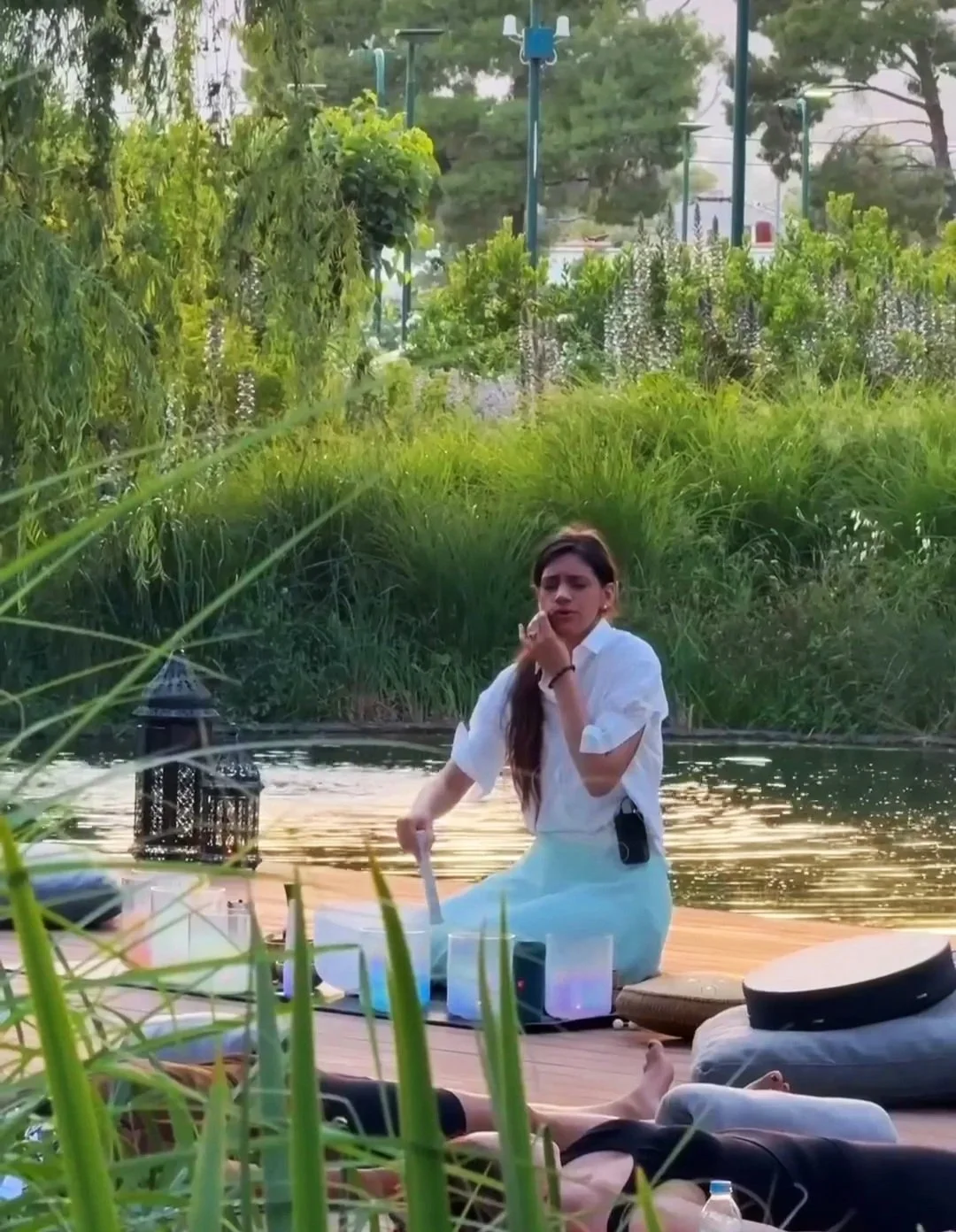
The Healing Power of the Human Voice
Among all sounds, the human voice is perhaps the most intimate and familiar.
Long before we understand language, we experience voice as vibration, rhythm, tone and presence. Even before birth, the developing baby is exposed to the mother’s voice inside the womb. In this sense, voice belongs to some of our earliest experiences of sound, relationship and human connection.
Perhaps this is one reason the voice can touch us differently from any instrument.
A voice does not simply produce a frequency. It carries breath, emotion, intention, resonance and human presence.
In Voice Sound Healing, the live voice becomes a gentle thread through the experience — sometimes surrounding the listener, sometimes appearing almost like a distant memory, and sometimes blending completely with the vibrations of the instruments.
Sustained vocal tones, humming, vowels, harmonics and overtones create a continuous field of sound in which the listener does not need to understand, analyse or respond.
There are no words to follow.
Nothing to achieve.
The invitation is simply to receive.
For some people, this quality of vocal sound can evoke a profound sense of familiarity, comfort and containment. Combined with slow breathing, stillness and a supportive environment, it may help create conditions in which the nervous system can begin to soften and the body can experience greater ease.
The intention is not for the voice to “heal” the body in a medical sense, but to use one of our most ancient and deeply human forms of connection as a pathway toward relaxation, regulation, emotional awareness and release, inner presence.
Held by the Human Voice
In this practice, the voice is also through toning, overtone singing and sustained vowel sounds. Each vowel carries a distinct resonance and may be experienced in a different way within the body. Without any accompanying instrument, the unaccompanied human voice creates a moment of profound stillness, sacredness and warmth—a space in which we are invited simply to receive and listen.
Before the session, you may choose to set an intention connected to something you would like to explore: an area of life that no longer feels in flow, an experience that has unsettled you emotionally or something within you that is asking to be heard. Nothing needs to be analysed or resolved. We gently make space for what is present, listen to it and allow ourselves to rest—even within what may initially feel uncomfortable.
An intention is never required. You may also enter the session without a theme or emotional process, allowing the voice to hold you while you simply relax and rest deeply.
How Sound Works with the Body
Sound is vibration. We perceive it primarily through the auditory system, while sufficiently strong low-frequency vibration — particularly from resonant instruments close to or in contact with the body — may also be experienced physically through the skin and tissues.
Long resonances, repetition, harmonics and overtones provide the mind with a continuous sensory focus. Unlike conventional musical listening, there is no need to follow a melody, anticipate a harmonic progression or analyse musical structure.
You are invited simply to listen and feel.
As attention turns inward, breathing may naturally become slower, muscular tension may soften and mental activity may feel less dominant. The combination of sound, stillness, breath and focused attention creates conditions that may support deep rest, nervous-system regulation, interoceptive awareness and a transition from constant doing into simply being.
People may experience deep relaxation, reduced perceived stress, emotional release, greater awareness of the body, mental spaciousness, imagery, meditative absorption, grounding or a sense of restoration.
There is no “correct” response to sound. Every nervous system listens differently.
Sound, Voice & Altered States of Consciousness
As the experience deepens, sustained voice, vibration, repetition and complex overtones may also support entry into Altered States of Consciousness (ASC) — experiences in which our ordinary patterns of attention, thought, perception or sense of time temporarily change.
Deep relaxation and meditative absorption can themselves involve such shifts.
As external stimulation becomes less important and analytical thinking quietens, awareness may become increasingly inward and receptive. Some people describe a different perception of time, spontaneous imagery, emotional processing, creativity, insight, profound stillness or a feeling of connection beyond their usual sense of self.
Meditative and deeply relaxed states are often associated with changes in brain activity, including alpha and theta patterns, although responses vary considerably and sound healing cannot be assumed to produce a particular brainwave state.
The purpose is therefore not to force an altered state.
There is nowhere you need to go.
Sound, voice and vibration simply create an environment in which you are invited to slow down enough to listen differently.
And perhaps this is the deepest dimension of Voice Sound Healing:
the voice does not ask you to become something else.
It invites you to become quiet enough to hear what is already within you.
Coming Back Home
The voice begins with breath.
Breath becomes vibration.
Vibration becomes sound.
Sound becomes listening.
And listening becomes presence.
A return to the body.
A return to the breath.
A return to stillness.
A return home — to yourself.
Private 1:1 or group sessions offered in Athens & Zürich