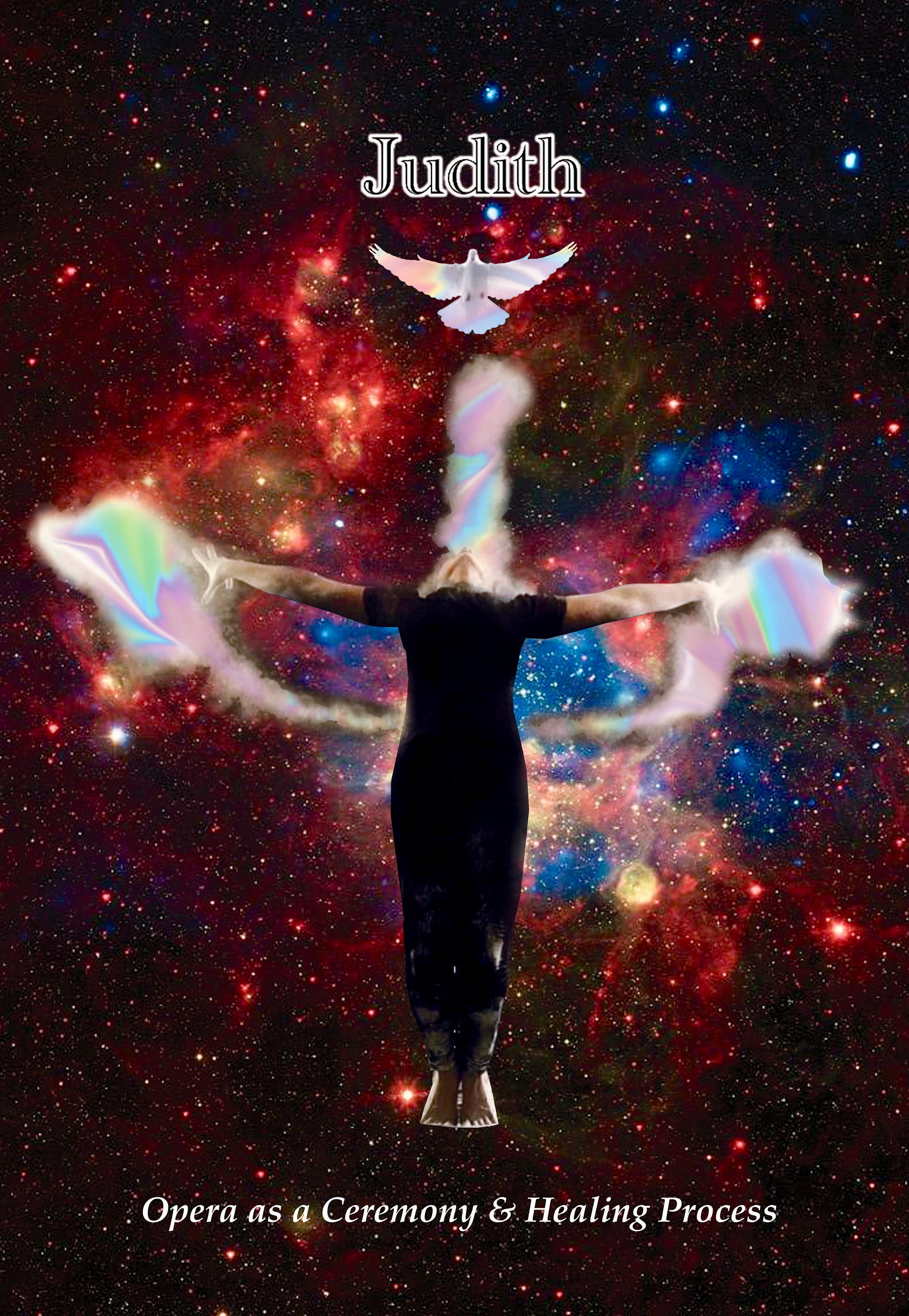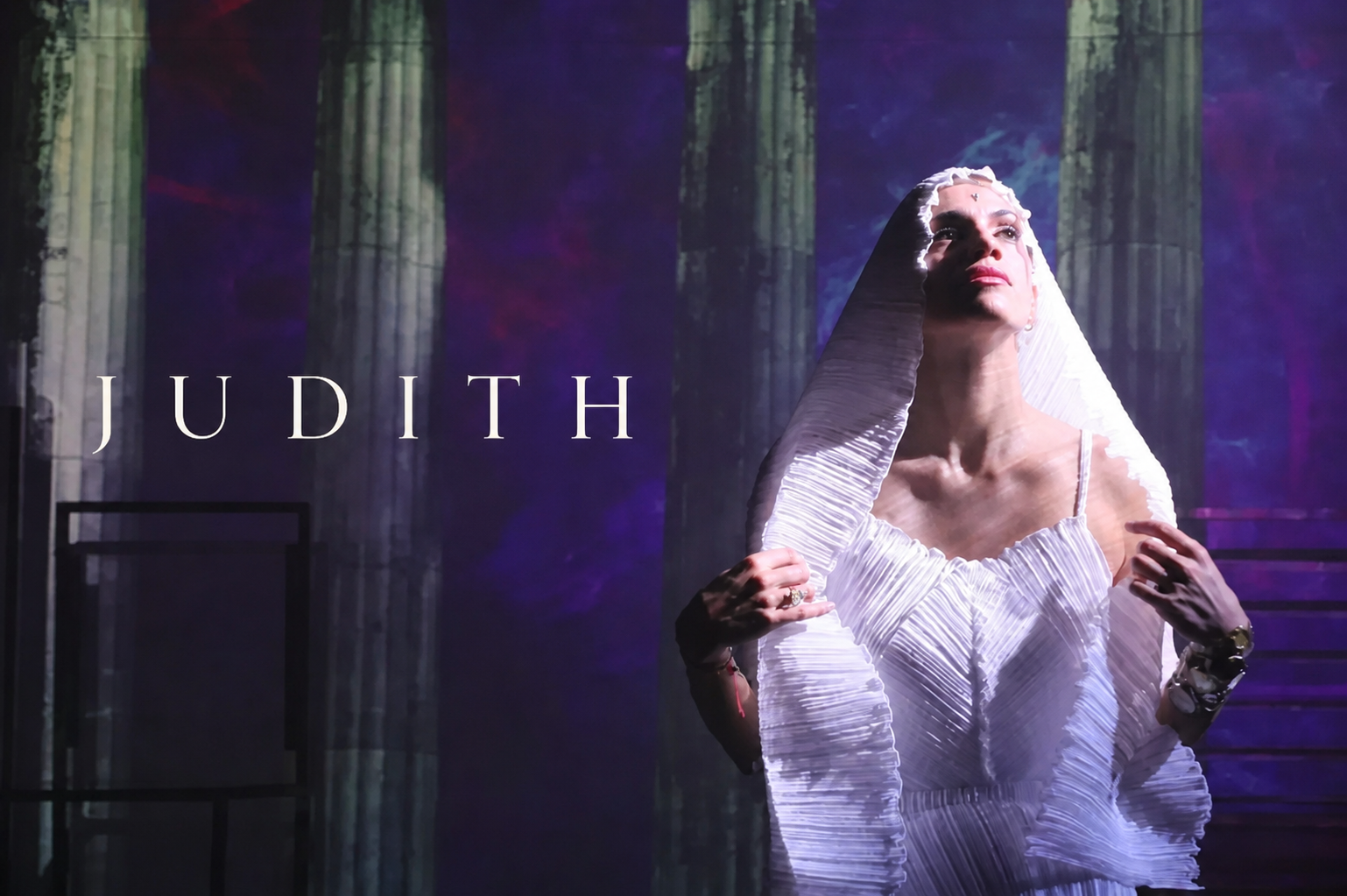
An Opera of Remembrance, Purification and Awakening
Judith is an original one-woman performance created, directed and performed by Leonora Gaitanou, inspired by Béla Bartók’s Bluebeard’s Castle and the symbolist libretto of Béla Balázs.
The work premiered in London as part of Tête à Tête: The Opera Festival 2023. Its journey continued at Teatro No’hma in Milan on 2024, where it represented Switzerland in the International Teresa Pomodoro Competition.
Yet Judith is more than a reinterpretation of an opera. It is an evolving exploration of Opera as a Ceremony & Healing Process—a search for how the operatic stage might recover something of the cathartic, ritual and transformative dimension once held by the arts.
A Work with Many Doors
Like Bluebeard’s castle, Judith contains many doors.
The work can be encountered as a story of female liberation, an exploration of patriarchal violence, a journey through ancestral memory, a descent into the human psyche or a spiritual passage towards remembrance and awakening.
No single interpretation is imposed upon the spectator.
Each person is invited to enter through the door that speaks to them and receive the layer of the work they are ready to encounter.

-
The actual Story Behind Judith
The first door opens onto the literal story from which Judith emerged.
Its origins lie in Bluebeard, the dark French tale published by Charles Perrault in 1697. It tells of a wealthy and feared nobleman whose previous wives have mysteriously disappeared. After marrying a young woman, Bluebeard leaves his castle and gives her permission to enter every room except one. He entrusts her with its key but forbids her to open the door.
Unable to ignore what has been concealed from her, she enters the forbidden chamber. There she discovers the bodies of Bluebeard’s former wives—the women he had married and murdered. When Bluebeard returns and realises that she has uncovered his secret, he prepares to kill her too. She is ultimately rescued by her brothers, who arrive before he can complete the murder.
The bride in Perrault’s tale is not named Judith, and the original story contains one forbidden chamber rather than seven symbolic doors.
More than two centuries later, librettist Béla Balázs and composer Béla Bartók transformed this tale into the one-act opera Bluebeard’s Castle. In their version, the young woman is named Judith. She willingly leaves her family and former life to follow Bluebeard into his dark castle, believing that her love can bring warmth and light into it.
The forbidden chamber of Perrault’s tale becomes seven locked doors.
The Seven Doors in Bartók’s Opera
The First Door — The Torture Chamber
Judith discovers a room of suffering and violence. Its walls appear to be stained with blood. This is her first encounter with the darkness hidden within the castle, yet she refuses to turn back.The Second Door — The Armoury
Behind the second door she finds weapons and instruments of war. Blood appears upon them too. The castle begins to reveal not only private suffering, but also the structures of power, conflict and domination that sustain it.The Third Door — The Treasury
The third chamber contains Bluebeard’s jewels, gold and accumulated riches. Even here, Judith sees traces of blood. Beauty and wealth cannot conceal the suffering through which power may have been acquired.The Fourth Door — The Garden
A magnificent garden is revealed, filled with flowers and living beauty. Yet Judith perceives blood upon the earth and the roots. Even what appears fertile and beautiful carries the hidden memory of violence.The Fifth Door — Bluebeard’s Kingdom
The fifth door opens onto the vast extent of Bluebeard’s realm. For a moment, the castle is flooded with light and Judith sees the immensity of his power. Yet the distant landscape remains shadowed by blood-red clouds.The Sixth Door — The Lake of Tears
Behind the sixth door lies a silent lake formed from tears. It is the emotional heart of the castle: the grief that power, wealth and beauty could not erase. Judith has now reached a threshold beyond which knowledge can no longer remain abstract.The Seventh Door — The Former Wives
Behind the final door Judith encounters Bluebeard’s three former wives. In Bartók and Balázs’s symbolic world, they are not presented simply as the murdered bodies described by Perrault, but as timeless figures who remain within the castle. Judith is clothed in their jewels and mantle and takes her place beside them, becoming associated with the night. The castle closes into darkness once more.This is the literal dramatic foundation of Leonora Christina Gaitanou’s Judith.
Her interpretation begins with this inherited story: a woman enters a man’s castle, insists on opening what has been kept hidden and crosses seven increasingly profound thresholds. From this narrative foundation, the doors gradually acquire further psychological, ancestral, social and spiritual meanings.
The first level tells us what happens.
The following levels ask what the story contains—and why it continues to speak to us.
-
The Performance
The work was created during the pandemic—a period of fear, isolation, grief and profound personal and collective questioning.
For Leonora, the images and symbols that emerged during the creative process often felt less like something she was consciously inventing and more like a form of ancient knowledge she was trying to remember.
The stage is approached as a sacred space rather than merely a place of representation. The architectural form of the Parthenon is transformed into Bluebeard’s Castle, and the seven openings between its columns correspond to the seven locked doors of the opera.
The temple becomes an image of the human soul.
What first appears to be a journey through Bluebeard’s castle gradually becomes Judith’s descent into her own psyche, body, memory and ancestral inheritance. The castle is no longer simply the domain of a man who imprisons women; it becomes the inner architecture in which personal and collective memories have been concealed.
Through voice, theatre, movement, symbolism and ritual, the performance invites the spectator to move beyond observation and enter their own process of reflection.
Judith does not offer an escape from reality. It functions as a wake-up call.
-
Ancestral Memory
For Leonora, Judith’s journey also became deeply personal.
The seven doors were reimagined as seven ancestral thresholds—seven generations of women within the genealogical line, reaching back towards the period in which the tale of Bluebeard first appeared.
Each former wife becomes the symbolic presence of an ancestral woman carrying a wound, a silenced emotion or an unfinished story.
What cannot be expressed does not necessarily disappear. Fear, grief, shame, anger, jealousy and powerlessness—as well as patterns of judgement, arrogance or cruelty—may leave traces within family relationships and be passed, consciously or unconsciously, from one generation to another.
Each door therefore contains something waiting to be witnessed, expressed and released.
Judith’s passage becomes a process of purification of the emotional body—not only from burdens carried through previous generations, but also from the emotions, wounds and patterns belonging to her own life.
She enters the darkness without turning away, willing to encounter fear itself: the fear that may have prevented earlier generations from facing what had happened to them. What could not be acknowledged was hidden, silenced or metaphorically swept beneath the carpet.
Judith now lifts that carpet.
What has remained concealed is brought into the light. The hidden emotions, memories and inherited patterns are allowed to emerge—not to overwhelm or condemn her, but so that they may finally be witnessed, transformed and released.
She does not open the doors only for herself. She enters the hidden chambers of her lineage, meeting what previous generations may not have been able to name or transform.
Her personal purification becomes an act of remembrance for those who came before her and an offering of greater freedom to those who may come after.
What begins within one woman’s story gradually opens into the collective field.
-
The Seven Doors
A Map of the Inner Being
The seven doors are, first of all, the actual doors of Bluebeard’s castle. In Bartók and Balázs’s opera, they reveal the torture chamber, the armoury, the treasury, the garden, Bluebeard’s vast kingdom, the lake of tears and, finally, the chamber of his former wives.
In Judith, however, each door opens simultaneously onto several layers of meaning. The castle becomes the architecture of the human psyche, and its locked chambers hold everything that has been feared, silenced, denied or left unseen.
Behind every door lies an emotion waiting to be acknowledged, an ancestral presence waiting to be witnessed and a wound seeking release. Each threshold evokes a woman who was controlled, silenced or killed within the long history of patriarchy—but also every man who was taught to suppress tenderness, vulnerability, intuition and receptivity in order to be considered strong.
The doors therefore reveal the wounds of both the feminine and masculine principles. Their opening becomes an invitation to bring these divided forces back into dialogue and balance.
Within the symbolic language of the production, the seven doors also correspond to the seven energy centres of the body. Each opening becomes an act of purification: a gradual release of emotional, ancestral and energetic material that prevents the human being from experiencing inner unity.
Around this central journey unfolds a wider constellation of seven: the seven colours of the spectrum, the seven notes of the musical scale and the seven traditional planetary archetypes. Colour, sound, movement and image accompany Judith as she moves from one threshold to the next, forming a ritual map of remembrance and transformation. These correspondences are not presented as fixed equations, but as interconnected languages through which the same inner journey may be perceived.
Bluebeard is no longer interpreted solely as an external antagonist. His disembodied voice gradually becomes the voice of the unknown—the Creator, the deeper consciousness or the part of the soul that calls Judith towards what she must face.
He does not rescue her, nor does he complete the journey on her behalf.
He presents the threshold.
Judith must choose to enter. She must choose to see.
Her determination to open every door becomes the soul’s refusal to remain separated from its own truth. By entering the darkness without turning away, she encounters what earlier generations were unable or afraid to face. What had been concealed is brought into the light, so that it may be witnessed, transformed and finally released.
The spectator is invited to enter their own inner castle:
What has been hidden within me?
Which emotion is asking to be heard?
Which inherited story am I ready to release?
Which door am I now ready to open?
-
Female’s Liberation · Dedicated to Mahsa Amini
The story of Bluebeard originates in a French tale published by Charles Perrault in 1697, concerning a powerful man whose former wives disappear behind the forbidden doors of his castle. Bartók and Balázs later transformed the tale into an intense psychological encounter between Bluebeard and Judith.
In Leonora’s interpretation, Judith refuses to become another silenced woman within this inherited story.
By opening the doors, she confronts what has been concealed and begins to reclaim the voice, agency, freedom and power denied to the women who came before her.
The original production of Judith was dedicated to Mahsa Amini, the young Iranian woman who died in the custody of Iran’s “morality police” after being arrested for allegedly wearing her hijab improperly.
For Leonora, her death represented an unbearable expression of the silencing of the feminine principle—a young woman deprived of her freedom, her voice and ultimately her life because her body and its expression were subjected to patriarchal control.
It marked a point at which the inner response could no longer remain silent:
This cannot continue.
Following Amini’s death, women in Iran and across the world cut locks of their hair as a symbolic gesture of mourning, resistance and solidarity. The act transformed hair—so often subjected to control—into a declaration of freedom.
The ancient Greek word thrix (θρίξ) means hair, but also energy. Within the symbolic language of the performance, hair is approached as a carrier of power and life force.
In the final ritual of Judith, she gathers the cut hair symbolically belonging to generations of women silenced throughout centuries of patriarchy. She carries not only the hair of the women of her own lineage, but the collective memory of all those whose voices, bodies and freedom were controlled or taken from them.
As she receives this ancestral and collective memory, Judith’s own hair begins to grow, descending until it reaches the floor. What had been cut returns. What had been silenced finds expression. What had been deprived of its life force begins to grow again.
Her lengthening hair becomes a visible extension of her reclaimed feminine power—connecting her body with the Earth, the women who came before her and the generations that will follow.
Through a spiralling, dervish-like dance, the accumulated grief is set into motion. The strands of hair follow the circular movement, carrying memory into transformation and creating the image of a living spiral.
The movement is no longer only an expression of mourning.
It becomes a ritual of rebirth.
From within the spiral, the feminine principle rises again—not in opposition to the masculine, but restored to its voice, dignity, creative power and sacred place within the whole.
-
Yin & Yang · A Call for Humanity
At the heart of Judith lies a call for humanity to restore the relationship between the feminine and masculine principles.
This is not a conflict between women and men. The feminine and masculine exist symbolically within every human being, regardless of gender. They embody complementary qualities that are called to meet within us: receptivity and action, intuition and reason, tenderness and strength, creation and structure, heart and mind.
As the journey unfolds, we begin to understand that Judith and Bluebeard are not entirely separate.
They are two dimensions of the same soul.
They are light and shadow, the wounded feminine and the wounded masculine, each carrying what the other has been unable to recognise. Judith enters the castle believing that the darkness belongs only to Bluebeard. Yet every door she opens leads her further into a shared inner world—and ultimately into aspects of her own psyche.
Bluebeard’s darkness is not presented merely as evil. It also contains buried pain, fear, emotional isolation and the inability to reveal vulnerability. Judith’s light is not without wounds of its own: it carries the longing to be seen, the impulse to save, inherited sorrow and the need to uncover the truth at any cost.
Their encounter becomes a mirror.
Through one another, both wounded principles are revealed.
Centuries of patriarchal conditioning have often privileged hierarchy over relationship, domination over cooperation, control over trust and relentless action over receptivity. Vulnerability has been treated as weakness, emotion separated from intelligence and humanity disconnected from the body, the Earth and the natural rhythms of life.
These structures have deeply wounded women, but they have also wounded men. They have silenced the feminine principle while imprisoning the masculine within expectations of control, emotional suppression, power and constant performance.
The healing of the feminine therefore does not require the rejection or defeat of the masculine. Nor can the masculine be restored while the feminine remains silenced.
The feminine is called to reclaim its voice, intuition, embodied wisdom, creativity and power. The masculine is called to release domination and return to its healthy qualities: conscious action, clarity, protection, direction, responsibility and presence.
Both principles are wounded.
Both are called to heal.
Both are called to listen.
Both are called to remember that they belong to one whole.
From this perspective, the journey of Judith becomes an attempt to heal and reunite the feminine and masculine principles within the human soul—and, through this inner restoration, within the collective field of humanity.
It invites us to descend beneath external conflict and recognise the conflict living within ourselves. The struggle between Judith and Bluebeard becomes the struggle between the parts of the self that seek connection and those that fear it; between the light that wants to reveal and the shadow that has learned to hide.
Healing begins when neither side is denied.
Humanity is called to move from the mind alone towards the intelligence of the heart—not by rejecting reason, but by allowing thought and feeling to enter a conscious relationship. When the mind serves the heart and the heart is supported by clarity, inner division can begin to soften.
The peace we seek in the world must first become possible within the human being.
When the wounded feminine and wounded masculine begin to recognise, forgive and restore one another, inner conflict can gradually become inner peace. That peace may then resonate outwards—from one person to another, through relationships, families, communities and future generations.
Judith’s liberation is therefore not only the liberation of one woman.
It is an invitation for humanity to move:
From domination to relationship.
From control to conscious responsibility.
From emotional silence to authentic expression.
From opposition to inner reconciliation.
From separation to connection.
From the mind alone to the wisdom of the heart.
From inner conflict towards a peace that may finally echo into the world.
-
The Spiritual Journey
Purification, Integration and Awakening
At its most esoteric level, the inner call of Judith is a call to purification.
The seven doors correspond symbolically to the seven principal energy centres of the human body. The journey begins at the root, within the territories of survival, fear, inherited memory and belonging. It gradually rises through relationship, personal power, the heart, expression and inner vision, until it reaches the crown.
Each door marks a stage of inner purification. An emotion is encountered, an inherited pattern is recognised and energy bound to an earlier experience is invited to move again. The journey asks us to release not only the emotional weight accumulated within our own lives, but also what we may carry from previous generations.
Within the spiritual language of the work, this is also understood as the purification of karma: the conscious meeting and transformation of patterns that continue to bind the soul to fear, repetition and separation.
As the energy centres are gradually purified, the Kundalini energy may symbolically rise from the root towards the crown. The awakening of the third eye represents the restoration of inner vision, while the opening of the crown points towards expanded consciousness *superconsciousness—a state in which the human being begins to remember and embody his fullest potential in the brain as a human being.
This ascent is not an escape from the body. It is an integration of all layers of being: body, heart, mind, soul and spirit.
Central to this process is the healing of the feminine and masculine principles within us. It asks us to meet the inner mother and father, to recognise their gifts and wounds and to restore a sacred relationship between receptivity and action, intuition and reason, tenderness and strength.
It also evokes a renewed cooperation between the left and right sides of the body and between the intelligence of the heart and the clarity of the mind. At the meeting point of these inner axes lies the throat—the bridge through which the inner world is given voice.
The liberation of the throat therefore becomes essential. What has been silenced can be expressed. What has remained divided can enter into relationship. Fragmented aspects of the self can gradually be heard, welcomed and reintegrated into the wider wholeness of the soul.
As these inner divisions begin to heal, the human being may move from fragmentation towards unity, from personality towards soul and from separation towards connection with Source. This movement can be understood as an awakening into superconsciousness: not a rejection of our humanity, but a fuller embodiment of its physical, emotional, creative and spiritual dimensions.
Within this symbolic reading, corona becomes more than the word associated with the pandemic. It also means the crown—the threshold of expanded awareness, remembrance and reunion with our deeper nature.
The work connects this inner ascent with humanity’s transition from the Age of Pisces towards the Age of Aquarius. Symbolically, this means leaving behind structures governed by fear, violence, war, division, rigid dogma and dependence upon external authority.
The emerging path calls instead for love, unity, conscious participation and personal responsibility. Rather than waiting for an external saviour, each person is invited to become responsible for their own healing, choices and relationship with the whole.
The movement is:
From fear towards love.
From separation towards unity.
From inherited repetition towards conscious choice.
From external authority towards inner responsibility.
From the silencing of the soul towards authentic expression.
From fragmentation towards sacred union.At its deepest level, Judith becomes a map for the purification and integration of the human being—a journey towards the sacred union of feminine and masculine, heart and mind, body and spirit.
No spiritual interpretation is imposed upon the spectator. This is one of the doors through which the work may be entered—available to those who feel ready to encounter it.
-
Conception, Direction & Performance
Leonora GaitanouInspired by
Béla Bartók’s Bluebeard’s Castle
Libretto by Béla BalázsAn ongoing journey:
2021
Conceived and presented as a first draft in Biel/Bienne
2022
Nominated for the FEDORA Opera Prize2023
World premiere at Tête à Tête: The Opera Festival, London2024
Presented at Teatro No’hma, Milan, representing Switzerland in the International Teresa Pomodoro Competition2026-
Is now shared with people through workshops
Credits:
Male Voice: Geoff Clapham
Piano: Konstantinos Papadakis
Set design & Video Art: Piedra Muda Lab
Lighting Design: Sergi Cerdán
Costume: Daphne Valente
Set construction & artistic residence: Brava! Performing Arts
Arrangement for smaller orchestra: Aristides Strongylis (in case of orchestral version)
Sponsors:
In London: Schwarz Foundation, Sumita Kumar
In Milan: Stiftung ERGATA
The Judith Project was shortlisted for the Fedora Opera Prize 2022. The Fedora Competition is for emerging artists with innovative ideas. Judith was representing the Greek National Opera.



Teaser 1
Video design: Piedra Muda LAB
www.piedramudalab.com
Teaser 2
Video design: Piedra Muda LAB
www.piedramudalab.com
Judith Invitation